It takes roughly three tonnes of rose petals to make one kilogram of Bulgarian rose oil, and the whole crop depends on a few weeks of the right weather each spring. In recent hot seasons, growers in the Valley of Roses have picked record daily volumes of flowers and then found that the heat had reduced the oil inside each petal. If you formulate with rose, that shows up as a supply problem and, before long, a quality conversation with your perfumer.
I used the rose as a case study in a recent B Beauty Coalition webinar, The Future of Beauty Depends on Nature: Are Our Supply Chains Ready?, because it shows something that gets lost in most corporate nature work. In my experience, teams run their footprint assessment and their risk assessment as two separate exercises, with different owners and often in different departments. However, nature risk is what you see when you read your impacts and your dependencies from the business's side of the ledger. Map those two properly and most of your risk picture is already in front of you.
What a beauty business needs from nature
A beauty business relies on healthy soil, fungi and water to grow its botanicals. It relies on ecosystem services it never pays for, such as pollination, pest control and the regulation of water and local climate. It draws on botanical and animal extracts, on the genetic diversity that gives new actives to work with, and on the cultural and aesthetic value of nature that sits behind half the brand stories in the category - greenery and nature-inspired visuals are frequently seen in marketing messages and visuals.
The last three seasons show what that looks like in the field. Bulgarian rose flowers depend on specific climatic conditions in the valley to grow well. In 2024 the harvest began in mid-April, a record early start according to one Kazanlak producer, and ran for 57 days. In 2025 a late cold snap hit buds that had been coaxed out early, and growers reported falling yields.
In 2026 the problem flipped again. Flower volumes started out higher than in either of the two previous years. Then unusually high temperatures in the second half of the campaign forced a rapid, compressed bloom. Distilleries took in record daily volumes of flowers, yet the heat had reduced the oil inside the petals. More roses produced less oil.
The heat created a labour problem on top. Growers struggled to find pickers even at higher wages, with cherry farms competing for the same people, so flowers stayed on the bush longer than they should have. A rose left out through a hot morning loses value by the hour.
In order to work out your key dependencies, the question to ask here is simple: what would we lose if this ecosystem failed? For a lot of brands the answer is a key ingredient, and with it a strategic product line.
What a beauty business does to nature
Impacts are the more familiar side, though usually only the climate slice of them gets measured. The useful frame is the five drivers of nature loss identified by IPBES: land and sea use change, direct exploitation of species, climate change, pollution and invasive species.
Sourcing is where land conversion bites, through palm oil, nuts, mica and flower fields, and where wild harvesting of plants and marine ingredients puts direct pressure on species.
Manufacturing adds water abstraction, energy use (affecting climate) and effluent, often in places already short of water. Agriculture takes about 70% of global freshwater withdrawals, and the cosmetics sector is competing for what remains with communities who need it to live.
Packaging is a forest and fossil-fuel question at the same time. Industry estimates put beauty packaging at more than 120 billion units a year, most of it plastic, and Zero Waste Europe estimates that around 70% of the sector's waste is packaging.
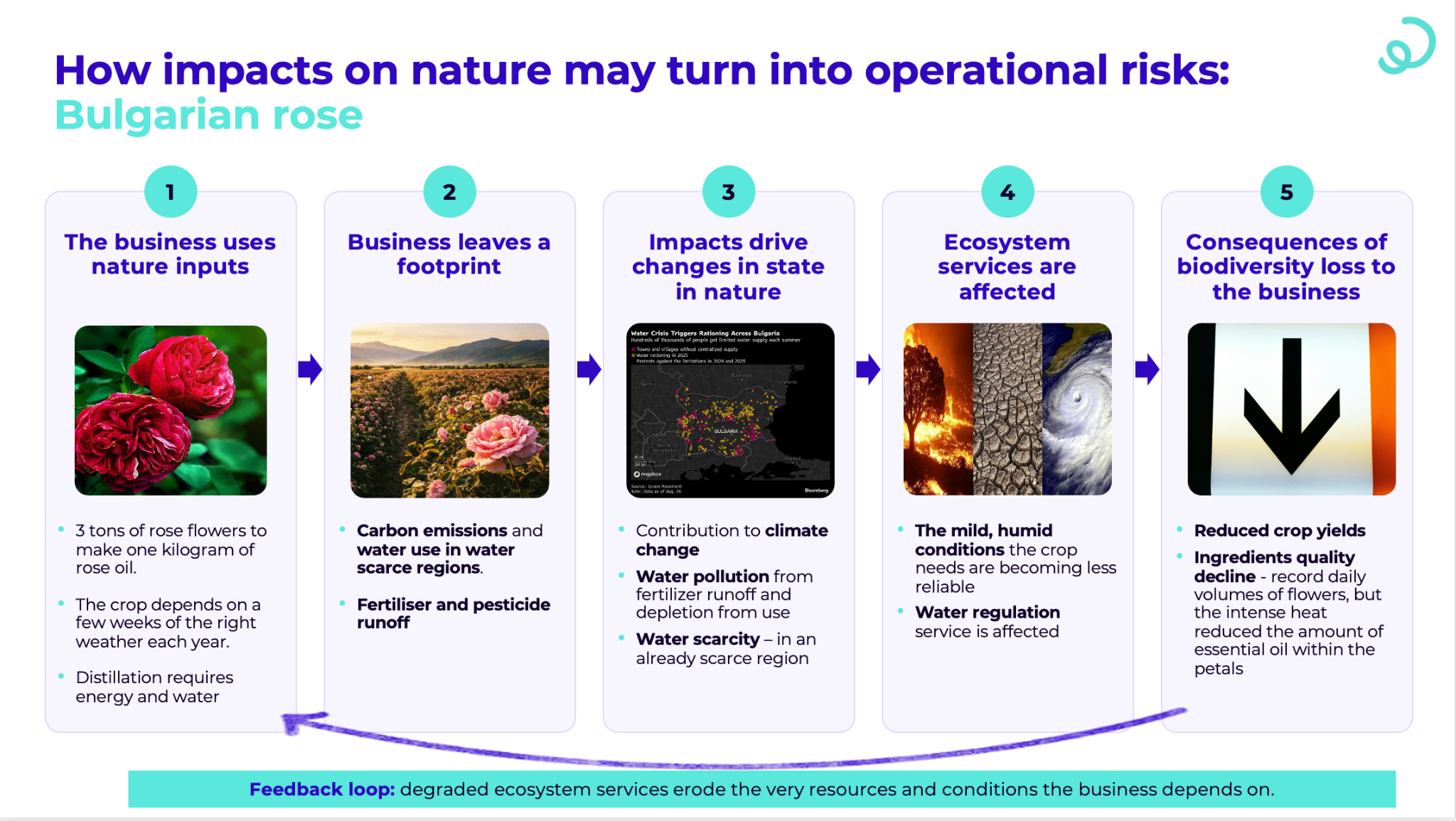
In our example - growing and distilling roses leaves a footprint: energy and water for distillation, fertiliser and pesticide run-off, a contribution to climate change. Distilling one kilogram of flowers leaves around four litres of liquid waste, rich in polyphenols that break down slowly. By our arithmetic that is somewhere between 12,000 and 16,000 litres for every kilogram of oil. Bulgarian researchers writing in 2022 noted that this wastewater is most often discarded into drains and rivers, and described it as a serious environmental problem, since polyphenols can inhibit nitrification and nutrient cycling in soil.
Damask roses are prone to fungal diseases such as black spot and powdery mildew, and the standard defence, conventional or organic, includes copper fungicides. A 2017 review of organic rose growing in Bulgaria flagged copper build-up in soil as a risk that needs reassessing, because it accumulates year after year and harms the soil life the plants rely on.
So the industry draws on clean water and healthy soil, and in places returns material that degrades both.
Then there is use, which brands rarely think of as theirs. When we measure carbon footprint of personal care brands, over two thirds of greenhouse gas footprint occurs at the use stage, mostly from heating water in the shower or bathroom sink. What goes down the drain afterwards ends up in rivers - ecotoxicity is not often assessed (human toxicity is).
The question on the impact side is: what are we changing in nature, and by how much?
Impact and dependencies become a risk
The Bulgarian rose shows the loop clearly: the pressures change the state of nature locally, with more water pollution, more demand on scarce water and less reliable mild, humid weather. The ecosystem services the crop relies on, water regulation above all, weaken. The consequence for the business is lower yields and lower oil content per petal - the impact has travelled all the way round and come back as a threat to the dependency. That feedback loop is the reason you cannot assess risks properly while ignoring the impacts and dependencies.
Where to act
The same mapping tells you where effort pays. In sourcing, that means regenerative farming, water stewardship in high-risk basins and, for some ingredients, biotech and green chemistry alternatives. A fermented or lab-grown active still depends on feedstocks, energy and water, so the dependency may move to a different place and still needs mapping.
In manufacturing, closed-loop water systems, renewable energy on site and green chemistry all reduce pressure and running costs together. Packaging has refill formats and newer materials such as mycelium and fibres. At the use stage, waterless and solid formats, formulas certified as non-ecotoxic and some consumer education address the part of the footprint usually left off the chart.
Impacts create your liabilities (through regulation and green claims scrutiny).
Dependencies create your exposure (on ingredient supply and price).
Map both before you prioritise - both provide cost savings.
Sources: FAO, Global Forest Resources Assessment 2020 Remote Sensing Survey (2022). IUCN Medicinal Plant Specialist Group via TRAFFIC, "Wild at Home" (2018). UNU-INWEH, "Global Water Bankruptcy" (2026). IPBES Global Assessment (2019). Zero Waste Week, cited in BeautyMatter (2025). Zero Waste Europe, cited by Business Waste (2024). Unilever Sustainable Living Plan. B Lab Standards (ESC1.4, 1.5, 1.7, 1.8, 2.2). TNFD LEAP guidance.
You have come to the place for thought leadership.