We have all just experienced one of the hottest summers on record in the UK and Europe. And it was not just hot - the financial accounts for many countries and companies ended up in the red too:
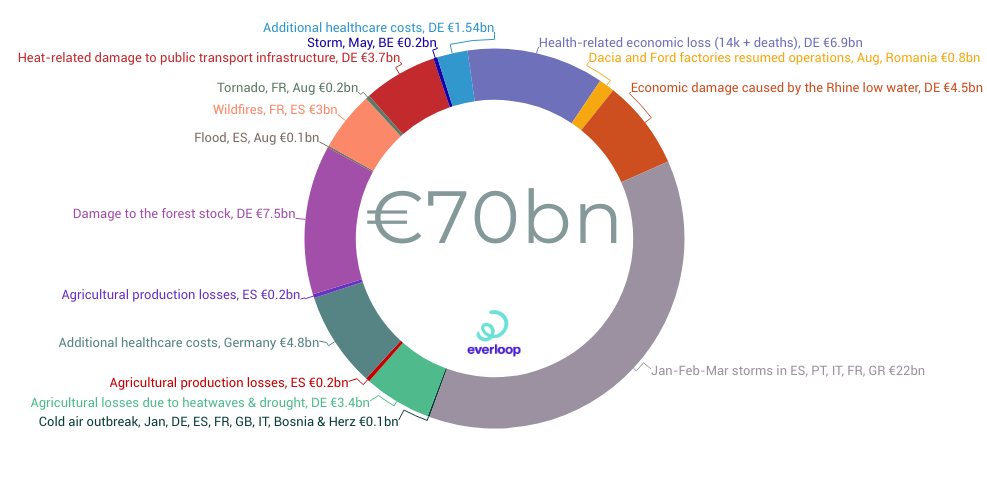
- So far in 2026, €70bn in climate-related economic damage across Europe, with more than €3.5 billion in losses from storms
- Repeated extreme heatwaves and water deficits across Europe have cost grain producers around €2 billion in lost revenue. Maize and potato yields are the smallest since 2018.
- Storms in Spain, Portugal, Italy, Greece and France accounted for €22bn.
- European wildfire costs this year have already surpassed €3bn.
- Spain’s wildfires burned 250,000 ha, and ravaged more than 10,000 hectares of farmland in 2026. Losses continue to grow after the recent storms in Tarragona and Catalonia.
- Extreme heatwaves and drought resulted in €36bn in economic damage in Germany alone - with crop failure (7% lower than last year) and additional healthcare costs. The German Central Bank has warned that inflation will rise.
- Hydropower plants in France, Austria and Serbia have been operating at historically low levels with widespread energy disruption. Nuclear reactors in Romania and Hungary were shut down for the first time in 44 years of service. Warm and shallow water in the Danube reduced the availability of cooling water, resulting in 25% power shortage in these countries.
What is not immediately visible from these numbers is how this affects business - and whether they can recover from these damages. European insurers have received claims for €5 billion for property damage but less than 20% will be covered. Here are some of the examples of climate events translating into real costs:
- Car manufacturers Dacia and Ford were forced to suspend production for 3 weeks in response to electricity shortages in Hungary and Romania. A quick estimate puts the revenue loss from closing two factories for three weeks at €0.8bn. Audi, BMW, Mercedes-Benz, Suzuki, and BYD's factories are also affected.
- Covestro, the chemicals and plastics company owned by the Abu Dhabi oil group Adnoc, declared force majeure at its Dormagen site because of transport difficulties. With more than 30% of its raw materials dependent on inland shipping, the company has been unable to meet some of its delivery obligations.
- Major German steelmaker ThyssenKrupp has experienced shortages in raw-material deliveries and consequently reduced hot-metal production.
- BASF, the German chemicals group, has faced severe logistical bottlenecks on the Rhine, forcing it to adjust production rates, invoke force majeure clauses and shift freight from barges to more constrained and expensive rail and road transport.
- Shallow waters on the Rhine River put pressure on supply chains. During July and August 2026, large barges were able to carry only 20–30% of their normal loads. Small charge per vessel means that additional journeys are required to move the same volume of cargo, increasing transport costs and limiting the amount of cargo that can realistically be moved. At their peak, spot freight rates rise tenfold, reaching €270 per tonne (normal rate ~ €20–30 per tonne). Overall transported tonnage on the Rhine fell to around 60% of normal levels during July and August 2026.
We are still to see the complete extent of the costs but there is also an opportunity to reduce exposure from the next round of climate events. Just like we are now seeing hotter summers, we will be seeing wetter winters, and after the drought, the state of the soil will mean that flash floods are very likely too.
Now is the time to prepare:
- Map where your exposure sits. Identify which sites, suppliers, server rooms, storage facilities and logistics routes sit in flood-prone or storm-exposed locations - not just owned operations but tier-2 and tier-3 suppliers, since a flooded input supplier or blocked port can halt production even if a company's own sites are untouched.
- Protect physical sites and stock. For any business holding physical assets or inventory, this means checking drainage and clearing gutters, culverts and site drainage before the wet season, moving stock, equipment, IT infrastructure and archives out of basements or ground-floor storage in flood-prone locations, securing or anchoring anything storm-exposed (signage, scaffolding, external plant, vehicles), and reviewing building resilience such as roof condition, window and door seals, backup power, ahead of the higher-wind months.
- Diversify and pre-position. This is the moment to line up alternatives and back up plans to your critical suppliers, logistics routes or concentration market. For exposed supply, consider holding slightly higher safety stock of business-critical inputs through the autumn. Stress-test for compound scenarios too: flooding combined with port congestion, a cyber incident, or existing financial strain, rather than modelling weather risk in isolation
- Revisit contracts and insurance now. Property and business interruption cover, force majeure clauses, and supplier contract terms - do you have any surprise storm/flood-specific exclusion?
- Build the early-warning habit into operations. Subscribing to and actively monitoring national meteorological warnings and EU-level flood forecasting lets any business trigger a pre-agreed response days ahead. Integrating early warning systems in the operational process helps to take timely action before the water damage arrives - time relocating stock, rescheduling deliveries, activating remote working, pausing site work.
You have come to the place for thought leadership.