In this third heatwave this year in the UK and Europe (or second? Fourth? I do not know, it is hot), and I am seeing more and more discussion on how European countries must adopt the AC culture.
And the problem is real - roughly 178,000 excess deaths were linked to the 2023 global heatwave alone, and an estimated 500,000 heat-related deaths occurred globally between 2000–2019. Notably, Europe (with only ~19% household AC penetration) has the world's highest per-capita heat-death rate, while the US (76% penetration) and Japan (90%+) have far lower heat mortality despite older populations - AC access appears to matter more than age here.
For me, AC always sounds scary - I fall ill every time I am in close proximity to an AC in small spaces. I have to switch it off in every hotel room and move away from it in meeting rooms. Otherwise - a week of cold and flu is guaranteed - with the full suite of symptoms and at least 2 days feeling like a fevered ghost. Every time. In fact, I have just recovered from a cold acquired in the wonderfully air conditioned spaces at the Climate Action Week events. Some of my other friends have even more “fun” fainting in AC spaces and suffering from dry eyes and coughs. Maybe a small price to pay for modern comfort?
So I decided to do a nerdy deep dive to figure out why. Where I got to is that the AC use not just about energy use, carbon and unsightly white boxes and vents sticking out from the walls - it is actually about our health, and the ways we seem to choose to pay dearly for poor design choices instead of building on the wisdom of centuries that we already have access to.
I welcome inputs and insights from people who have expertise in the AC subject and health implications to add to or correct this.
Environmental impact of AC
This one is easy. AC accounts for roughly 3–3.2% of global greenhouse gas (GHG) emissions once refrigerants are included: electricity demand (and where that power isn't renewable, it means more fossil fuel burning) and refrigerant leakage. F-gas refrigerants can have a global warming potential hundreds to thousands of times that of CO2, and leakage accounts for roughly a third of cooling's total climate impact. In the UK, the IEA flags AC as one of the fastest-growing sources of electricity demand, which matters given the National Grid's existing strain, further compounded by additional rising data centres and AI demands.
People impact - the overlooked part
Turns out, several mechanisms stack here.
- Cold air doesn't just feel uncomfortable. It switches off part of your nose's own antiviral defence - a 2022 study found a nearly 42% drop in the immune particles nasal cells release to fight viruses once the air cools from 37°C to 32°C. Rhinoviruses, meanwhile, replicate better in exactly that cooler range. So my nose's own defences are being switched off right when they're most exposed to whatever's circulating in a poorly ventilated room - and especially in exposure to viruses and bacteria my body is not used to, if i am in a hotel, a different country or a space full of people (hello, tube!). So this helps me understand my AC flu mystery.
- Cold rooms (especially a rapid transition from heat into strong AC) may trigger a "cold shock" response: skin cooling causes a sharp sympathetic surge and blood vessel constriction, and in some people this is followed by a vagal nerve overcorrection that drops heart rate and blood pressure abruptly. If blood pressure falls faster than the brain can compensate, you faint. People vary in how sensitive their reflex is - some people faint from cold drinks, sudden pain, or even standing up too fast, for the same underlying reason. It's a nervous-system reflex quirk rather than anything to do with immunity, and it can run independently of any illness and could be a plausible explanation for reacting to large drops in temperature when coming into a very cold space from the heat.
- Dry, cold air irritates mucous membranes directly - dries out eyes, throat and nasal passages, which is why sore throats and coughing show up fast.
- Poorly maintained units recirculate dust, pollen, pet dander and mould spores that collect in filters and ducts, so the "AC" sickness is often really an allergy or filter-hygiene issue.
- Badly maintained cooling towers and evaporative systems can harbour Legionella bacteria, and inhaling contaminated aerosol can cause Legionnaires' disease - in the UK this caused 229 infections and 10 deaths over one ten-year period, though this is specific to cooling-tower systems rather than domestic units.
- All this contributes to something called Sick building syndrome (SBS) - a new term I learned. It is a cluster of nonspecific symptoms: headaches, fatigue, irritated eyes/throat, difficulty concentrating, that's notably more common in sealed, mechanically ventilated or air-conditioned buildings than naturally ventilated ones.
So all of this is an occupational health issue with a documented biological mechanism behind it, and most health and safety policies haven't caught up to it.
This is showing up in the business balance sheet: SBS costs US employers an estimated $15 billion a year in lost productivity and absenteeism, and it shows up in somewhere between 20 and 55% of office workers. One study across 3,720 workers in 40 buildings found that floors with better ventilation had a 35% lower absence rate than the poorly ventilated ones. It affects an estimated 20–55% of workers in air-conditioned or sealed buildings, and a widely-cited 1984 WHO estimate, still referenced by the EPA, up to 30% of new or remodelled buildings show elevated SBS complaint rates.
Temperature has its own well-documented productivity cost, independent of illness. In a 2004 study, Cornell ergonomics professor Alan Hedge tracked temperature and typing performance across nine workstations at an Orlando insurance office over a full working month. At 77°F (25°C), staff were actively typing 100% of the time with a 10% error rate; at 68°F (20°C), that dropped to 54% of the time typing, with a 25% error rate. Hedge's own conclusion, presented at the Eastern Ergonomics Conference that year, was that the colder setting was costing the business real money in lost output, not just comfort
The very cold setpoints common in commercial buildings are a double cost: energy spent over-cooling, plus a productivity penalty from occupants working less accurately and comfortably.
Why do the AC spaces feel freezing?
AC does feel good when you enter the cooler space from the heat. Whenever I have gone into the AC spaces though, I always wondered why they feel so much colder than may feel comfortable? Especially in very hot countries - you need a coat inside, and way too hot outside.
Fun fact: most offices still run on a comfort standard built in the 1960s and calibrated to the metabolic rate of a 40-year-old, 11-stone man, which is why women prefer offices roughly 3 degrees warmer than the standard delivers. This is well documented as a "gender bias" in office climate control, though in practice it under-serves anyone with a lower metabolic rate, not only women. This is why half the workforce is wrapping themselves in scarves at their desks while the AC runs harder than it needs to.
Thermoregulation itself varies a lot between people - research shows resting metabolic rate differences of up to 58% between individuals, and factors like age, sex, body composition, menopausal status and even circadian rhythm all shift a person's comfort zone. Older adults are especially vulnerable because aging blunts sweating and blood-vessel responses, so their bodies compensate for cold or heat stress less effectively. People with asthma, autoimmune conditions, or anything causing congestion are more reactive to dry/cold air.
On top of that, commercial spaces often oversize systems to handle worst-case heat loads (direct sun, packed occupancy, computer equipment), and running colder than necessary is sometimes used, rightly or wrongly, as a marker of a well-functioning, "premium" system - cold air reads as effective air conditioning to occupants.
The commonly cited engineering guidance is to keep the indoor-outdoor gap within about 5–10°C specifically to avoid overloading these reflexes - which is well above the 15–20°C swings you get when outdoor heat is 35°C+ and indoor AC is set to 16–18°C. That gap is squarely in the range associated with the thermal shock and immune-suppression effects described above.
People habituated to hot, humid climates also tend to tolerate heat (and AC-driven cold) differently than those who live in heavily air-conditioned environments year-round, since regular AC exposure can itself reduce heat acclimatisation over time.
The more AC we have, the hotter we will feel outside…
So the implications of this for those in Europe, and those who are just getting used to the novelty: The actual failure is architectural and behavioural, not technological. We built ourselves into this corner with airtight insulation designed purely to hold winter warmth in (which, unhelpfully, also holds summer heat in), and open-plan floors with no operable windows and therefore no fallback once the mechanical system is the only option left.
Retailers leave the front doors wide open and run the AC against the draft. Warehouses go up in bare metal cladding because it's cheap, then spend 30% of their energy budget fighting the heat that cladding lets straight in. We designed the problem, and are now buying expensive tech to deal with it.
The question for a business isn't "AC or no AC”, it is a hierarchy of existing solutions.
The good news is that public health and energy bodies (WHO, IEA, the UN's Cool Coalition) generally converge on the same answer - exhaust the free and low-energy options first, then use efficient mechanical cooling, then reserve full refrigerant-based AC as a backstop specifically for people who are medically vulnerable or when passive measures aren't enough.
Layer 1 — passive building measures (do this first, largest leverage)
- This is where most of the win is available with zero running-cost or health downside.
- Shading (external blinds, overhangs, trees), insulation, and reflective or "cool" roofs reduce heat gain before it ever becomes a cooling problem. These can cut cooling demand by up to 80%, and techniques like night-time natural ventilation (open windows at night, closed curtains/blinds by day - I am practicing these this week as I write this) can lower indoor temperatures by up to 9°C without any mechanical input.
- Cool roofs alone cut a building's AC energy use by 5–20%, and can lower peak surface temperatures by over 3°C; green roofs add similar benefits plus stormwater and air-quality gains.
- At a system level, the IEA/Sustainable Energy for All coalition estimates passive cooling measures deployed at scale could cut global cooling demand growth by 24% by 2050, avoiding roughly $3 trillion in new equipment costs and 1.3 billion tonnes of CO2e.
Historical architecture also gives us a clue:
- Windcatchers pulled cool air through Middle Eastern buildings using nothing but wind and a tower shape

- Smaller sized windows protected from too much sun coming into the room vs the modern fully glazed buildings.
- Mashrabiya screens shaded glare and humidified incoming air at the same time.

- Mediterranean and European buildings have shutters blocking the sun outside the glass, which every study on shading strategy still confirms works better than any blind fitted on the inside.

- Thick masonry walls absorbed the day's heat and let it go slowly overnight. None of it required electricity.
- Perforated stone, brick or wood screens - Jaali - let breeze and diffused light through while blocking direct glare, similar in spirit to mashrabiya.


- Verandas created a shaded transitional buffer zone between the harsh outdoors and the interior, cutting solar gain on the walls behind them.
- Stilt houses raised the living floor above ground level, letting air circulate underneath and cooling the structure from below while also escaping ground-level humidity and heat.
- Thick thatched roofs, layered with natural air pockets, acted as strong insulators against direct sun.
- Courtyards and cross-ventilation layouts, often used in Central Asia, are estimated to cut mechanical cooling needs by as much as 50% when properly designed.

Most of it required a building shaped with the climate in mind rather than against it, and a bit of patience with night-time ventilation instead of a thermostat set to 18 degree. None of this involves cold recirculated air, so helps prevent the sick-building and thermal-shock issues entirely. Passive measures alone could cut projected global cooling demand growth by 24% by 2050.
Layer 2 — efficient mechanical cooling, matched to climate
Where mechanical cooling is genuinely needed, the choice of technology matters:
- Evaporative coolers use 50–90% less electricity than compressor-based AC because they have no compressor at all - they only work well in dry climates (they add humidity, which is counterproductive somewhere humid like coastal UK or the Gulf).
- Heat pumps (including ground-source) are the best all-rounder: far more efficient than resistive heating or conventional AC, and they double up for winter heating, which is relevant to your original UK question about cold-period alternatives.
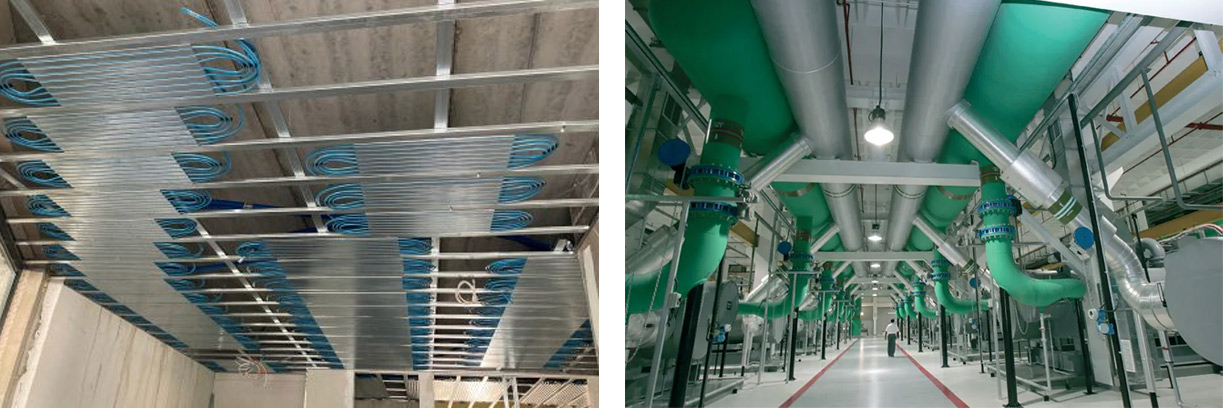
- Radiant cooling (chilled water through floor/ceiling panels) is efficient and quiet, avoids blowing dry recirculated air across people's faces (removing much of the dry-throat/dry-eye irritation and airborne-allergen recirculation problem), but needs a well-insulated, low-humidity envelope to work properly.
- At district scale, the Middle East's approach of centralised district cooling is the closest thing to a proven large-scale efficiency fix - it could supply ~30% of Gulf cooling demand by 2030 while avoiding 20GW of new power plants.
Layer 3 — personal/targeted cooling rather than whole-room refrigeration
Electric fans are recommended by updated public health guidance as effective up to about 40°C air temperature (revised from older guidance that capped it at 35°C), because they aid sweat evaporation - cheap, low-energy, and without the dry, cold recirculated air.
Fans are not a substitute for AC in the most extreme heat for vulnerable people as they lose effectiveness once air temperature exceeds skin temperature.
Old fashioned hand held fans do the job potentially even better, and have a nicer aesthetic.

Layer 4 — policy and vulnerable-population safety nets
WHO-backed heat action plans identify at-risk groups (elderly, those in care homes, outdoor workers, people without home cooling) and route them to cooling centres: libraries, pools, community centres, sometimes partnered cinemas, during heat warnings, rather than relying on universal home AC ownership. Japan and the US owe much of their lower heat mortality to near-universal home AC access, but both also run cooling-centre networks as a backstop for people without it, which is the more targeted, lower-energy piece of the toolkit worth scaling, even if it isn't yet a substitute for the AC-access gap itself.
So we can all go hang out in the malls or museums, or even better - the parks - when the heat comes.
So when it comes to climate adaptation measures, increased heat is not just about “putting AC in your shopping cart” for individuals or businesses, more thought and consideration needs to be given to it. Simplifying the solution to a Buy-now button is actually just shooting ourselves in the foot and making things worse the next year and year before and affecting human health in a way that is not even often considered. Climate risk and adaptation in business is not about the reporting burden, or a couple of clicks on a climate risk tool that promises to take away the burden.
I am off to buy kitchen blinds - whoever thought that no window treatments in a sunny kitchen was a good idea?
You have come to the place for thought leadership.